
In the pursuit of efficiency and environmental compliance, modern automotive manufacturing has shifted toward water-based paints. While eco-friendly, these coatings are often thinner and softer than their solvent-based predecessors, making luxury vehicles significantly more susceptible to physical damage.
For years, enthusiasts relied on carnauba waxes and, more recently, ceramic coatings. While these solutions offer excellent UV protection and hydrophobic properties, they lack the shear strength to prevent rock chips, scratches, and road debris impact. This is where the comparison of coatings vs. films becomes critical: while coatings are chemical barriers, Paint Protection Film (PPF) is a physical sacrificial layer.
Today, we analyze the engineering leap from simple plastic covers to advanced, optically clear polyurethane shields.
Early iterations of paint protection, often referred to as “Helicopter Tape” (due to its military origins), were constructed from PVC (Polyvinyl Chloride). While durable, PVC had significant drawbacks: it was prone to cracking, had a noticeable “orange peel” texture, and eventually succumbed to UV degradation, turning unsightly yellow.
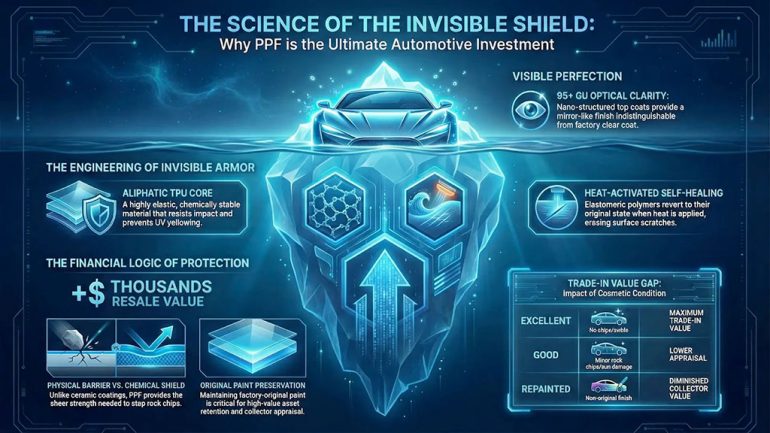
The industry has since transitioned to Thermoplastic Polyurethane (TPU). Unlike PVC, TPU is highly elastic and chemically stable.
The performance of a premium PPF relies on a complex multi-layer structure, typically involving a release liner, an acrylic adhesive, the TPU core, and a functional top coat.
Achieving a mirror-like finish requires advanced coating structures that align seamlessly with the vehicle’s clear coat. For instance, industry innovators now utilize specialized nano-structures, such as ClearPro’s Polyoptico™ coating technology, which arranges inorganic metal compounds to enhance surface flatness. This engineering allows the film to deliver a high-gloss finish (often exceeding 95 GU) that is virtually indistinguishable from factory paint, effectively solving the clarity issues found in older films.
The “magic” of modern PPF lies in the top coat’s elastomeric polymers. These polymers exist in a semi-solid state. When the surface is scratched (displacing the polymers), the application of heat—whether from the sun, a heat gun, or hot water—excites the molecules. This energy causes the polymers to revert to their original, lowest-energy state, effectively “healing” the scratch and maintaining a flawless surface.
Depreciation is the biggest cost of car ownership, but cosmetic damage is the variable you can control. According to J.D. Power’s guide on beating depreciation, external imperfections like rock chips, dents, and scratches can significantly limit a vehicle’s potential resale value. By sealing the factory paint under a self-healing layer, you are effectively freezing the car’s exterior condition in time, ensuring it remains in the ‘Excellent’ tier when you decide to sell.
Even the most advanced material science fails if the installation is poor. The “invisible” look depends on two key factors:
Note: If you are considering changing the look of your vehicle entirely rather than just protecting the paint, refer to our Guide to Vehicle Wrapping for a breakdown of vinyl vs. PPF aesthetics.
| Area | Key Takeaway | Impact/Data |
| Material | Shift to Aliphatic TPU | Eliminates UV yellowing/cracking |
| Protection | Physical film beats chemical coatings | Withstands rock chips (high shear strength) |
| Innovation | Heat-activated self-healing | Elastomeric polymers erase scratches |
| Aesthetics | Nano-structured surface leveling | >95 Gloss Units (Matches factory paint) |
| ROI | Preserves “Original” paint status | Maximizes KBB “Excellent” trade-in value |
| Execution | Requires wrapped-edge installation | Ensures invisible/seamless finish |
For leased vehicles, daily drivers exposed to highway debris, or exotic cars intended for future resale, next-gen PPF offers a tangible ROI. By combining hydrophobic top coats with impact-resistant TPU, modern films provide a solution that wax and ceramic coatings simply cannot match: peace of mind at 70 mph.

Automotive Addicts Contributors are a collective of guest writers, industry professionals, and passionate enthusiasts who bring fresh perspectives to the Automotive Addicts platform. Focused on delivering timely news, in-depth reviews, and unique insights, these contributors help keep the site dynamic and engaging. Many use the platform to expand their reach and build credibility within the automotive media world, adding depth and variety to the content that drives the Automotive Addicts community.

Automotive Addicts Contributors are a collective of guest writers, industry professionals, and passionate enthusiasts who bring fresh perspectives to the Automotive Addicts platform. Focused on delivering timely news, in-depth reviews, and unique insights, these contributors help keep the site dynamic and engaging. Many use the platform to expand their reach and build credibility within the automotive media world, adding depth and variety to the content that drives the Automotive Addicts community.


