
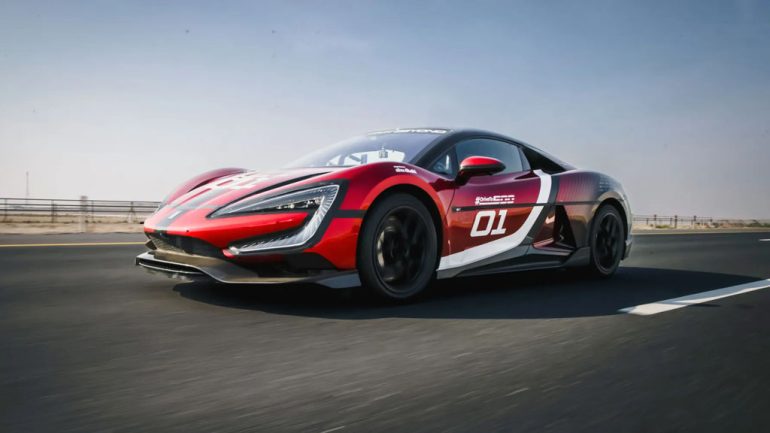
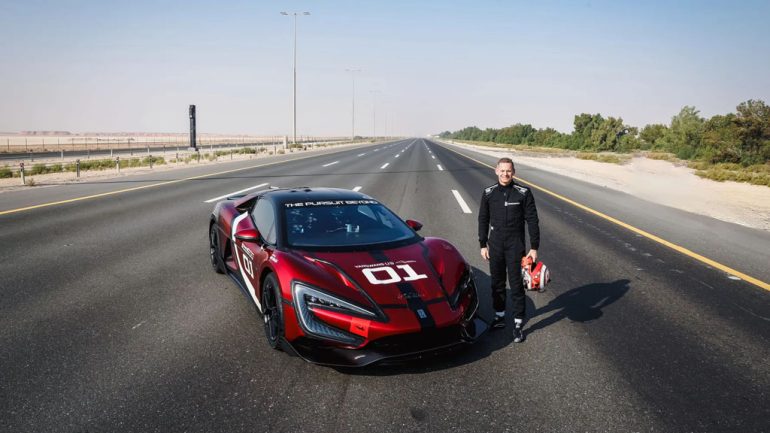
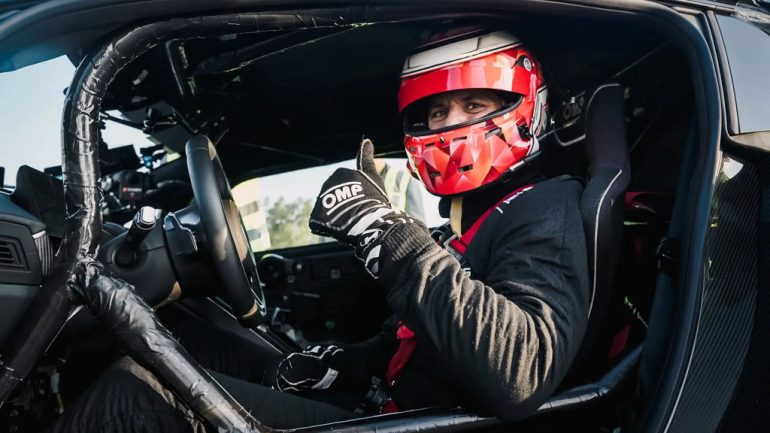
The automotive world has officially entered the 300-mph club’s next chapter, and the latest record holder isn’t a Bugatti, Koenigsegg, or any other familiar European hypercar manufacturer. Instead, it’s an electric hypercar from China that has just accomplished something extraordinary. The BYD Yangwang U9 Xtreme has reached an incredible 312.65 mph (503.17 km/h), becoming the first production car to break the 500-km/h barrier in a verified single-direction speed run. The achievement took place on November 1, 2026, in Abu Dhabi, with professional racing driver Marc Basseng behind the wheel. Even more impressively, the Fédération Internationale de l’Automobile (FIA) has formally recognized the result, giving BYD and its luxury Yangwang brand a legitimate reason to celebrate.
For a little perspective, 312 mph means the U9 Xtreme was traveling approximately 458 feet every second. That’s nearly the length of a football field and a half in the blink of an eye, making even the slightest steering correction or unexpected road imperfection a serious consideration. The record was established on a specially closed section of Sheikh Khalifa Bin Zayed International Road in Abu Dhabi’s Al Dhafra region. Authorities shut down roughly 6.2 miles of highway, providing a straight section measuring approximately 4.3 miles for the actual high-speed attempt. Unlike a purpose-built automotive proving ground, this was a public highway temporarily converted into a record-setting venue, which meant carefully preparing the surface and ensuring that debris, sand, and other hazards wouldn’t compromise the run.
The record didn’t come easily, either. Yangwang engineers initially conducted two attempts on October 31, reaching approximately 304.5 mph but falling short of the magic 500-km/h mark. Rather than settling for an already astonishing speed, the team spent the night refining the car’s setup. Engineers adjusted the aerodynamic balance, modified the rear wing to improve stability, recalibrated the active suspension, and fine-tuned tire pressures. They also improved their preparation procedures to ensure the battery and electric motors operated at their ideal temperatures. When testing resumed on November 1, the second run finally delivered the breakthrough, recording 503.17 km/h and surpassing the vehicle’s previous 308.34-mph achievement in Germany from September 2025.
Naturally, none of this would have happened without an absolutely outrageous amount of power. The Yangwang U9 Xtreme uses four independently controlled electric motors producing a combined output of approximately 2,977 horsepower. Each motor contributes roughly 744 horsepower, giving the car more than twice the output of the already impressive standard U9. The powertrain operates on an advanced 1,200-volt electrical architecture, allowing the vehicle to deliver enormous amounts of power while managing the electrical and thermal demands associated with extreme acceleration. Sophisticated torque-vectoring technology controls power delivery at each wheel, helping maintain stability when traveling at speeds that most production cars will never come close to achieving.
One of the more fascinating aspects of this achievement involves the tires. Generating nearly 3,000 horsepower is impressive, but transferring that power to the pavement safely at more than 300 mph presents an entirely different engineering challenge. Yangwang partnered with Giti Tire to develop specialized semi-slick tires designed to withstand the tremendous centrifugal forces and heat generated at these speeds. Engineers also paid particular attention to the connection between the tires and wheels, helping minimize unwanted movement under extreme acceleration and braking. At 312 mph, even minor tire irregularities could have catastrophic consequences, making this one of the most critical parts of the entire project. It’s a reminder that breaking top-speed records requires far more than simply adding horsepower.
There’s also an important distinction worth making about the record itself. The U9 Xtreme’s 312.65-mph achievement was recorded in a single direction rather than as an average of two runs in opposite directions, the latter being the traditional standard used for certain production-car speed records. That difference matters because wind conditions and road gradients can influence results. Nevertheless, the FIA recognized the measured speed, and the car earned two Guinness World Records, one for the highest speed achieved by a production car in a single-direction run and another specifically for an electric production car. The result doesn’t replace every existing two-way production-car speed record, but it unquestionably establishes a remarkable benchmark for peak speed. More importantly, it confirms that an electric production hypercar has officially crossed a threshold that internal combustion-powered manufacturers have been chasing for years.
As impressive as that straight-line performance is, the U9 Xtreme has another achievement that arguably tells us even more about its engineering. The same hypercar specification previously recorded a Nürburgring Nordschleife lap time of 6 minutes and 59.157 seconds, setting a production electric vehicle lap record around the legendary German circuit. That’s particularly noteworthy because building a car capable of reaching 312 mph is not necessarily the same as developing one that can corner, brake, and handle the constant elevation changes of the Nürburgring. Yangwang has managed to demonstrate both capabilities, showing that its extreme powertrain is supported by serious chassis engineering, sophisticated suspension technology, and substantial aerodynamic development. It’s hard not to respect that combination, regardless of what badge appears on the hood.
Of course, don’t expect to see a Yangwang U9 Xtreme pulling up beside you at the local grocery store anytime soon. BYD plans to produce just 30 examples worldwide, making this an exceptionally rare machine intended for a very select group of customers. Its development has also progressed at a remarkable pace. The original U9 was reaching approximately 192 mph in early 2024 before advancing to nearly 244 mph later that year. By August 2025, the more extreme version had reached 293.5 mph, followed by 308.34 mph just one month later. Now, barely a year after that achievement, the company has crossed 312 mph. That kind of progress illustrates just how aggressively Chinese manufacturers are investing in high-performance electric vehicle technology, and it’s becoming increasingly difficult for established supercar brands to ignore.
From our perspective, the Yangwang U9 Xtreme represents a significant turning point in the ongoing battle between electric and combustion-powered performance cars. We’ve always appreciated the mechanical drama of a powerful gasoline engine, particularly the sound and character delivered by the incredible machines from Bugatti, Koenigsegg, and other exotic manufacturers. That hasn’t changed. In fact, this achievement makes us wonder what the next generation of combustion-powered hypercars might accomplish if engineers were given complete freedom to chase maximum performance without the increasingly complicated regulatory constraints surrounding their development. Still, there’s no taking anything away from BYD here. A Chinese electric hypercar has just reached 312.65 mph on a closed public highway, earned FIA recognition, and secured two Guinness World Records. That’s an extraordinary engineering accomplishment, and we’re genuinely excited to see how the established hypercar manufacturers respond. The 500-km/h barrier has finally fallen, and something tells us the battle for the next record is only getting started.

Lloyd Tobias is a seasoned automotive journalist and passionate enthusiast with over 15 years of experience immersed in the world of cars. Whether it’s exploring the latest advancements in automotive technology or keeping a close pulse on breaking industry news, Lloyd brings a sharp perspective and a deep appreciation for all things automotive. His writing blends technical insight with real-world enthusiasm, making his contributions both informative and engaging for readers who share his love for the drive. When he’s not behind the keyboard or under the hood, Lloyd enjoys test driving the newest models and staying ahead of the curve in an ever-evolving automotive landscape.