
For decades, roadside recovery looked relatively straightforward: hook up the disabled car, lift one end, and get it off the road. Modern vehicles have made that job far more complicated.
All-wheel-drive systems, electric drivetrains, low-profile bodywork, electronic parking brakes, adaptive suspension and increasingly integrated electronics mean that moving a disabled vehicle now requires much more attention to how the car was designed.
The result is that towing equipment has had to evolve along with the vehicles it carries.
One Towing Method No Longer Fits Every Car
A traditional wheel-lift truck remains useful for many recovery situations, but there are vehicles that should not simply be moved with two wheels left rolling on the road.
The reason is usually mechanical: depending on the drivetrain, rotating one axle while another remains stationary can place stress on transmissions, differentials or electric drive components. Manufacturer instructions can vary significantly even between models from the same brand.
That is why the first step in a modern recovery is increasingly about identifying the vehicle rather than immediately attaching equipment. Drive layout, transmission type and manufacturer towing procedure all matter.
AWD Systems Complicate Recovery
All-wheel-drive vehicles have become common far beyond the traditional off-road segment.
Crossovers, performance sedans and electric vehicles can all use systems that distribute torque between multiple wheels. That improves traction on the road, but it may reduce the number of acceptable ways to transport the vehicle after a breakdown.
Some vehicles require all four wheels to remain off the ground during transport. Others permit specific procedures only after certain modes or mechanical settings have been activated.
This is where flatbeds, dollies and different wheel-lift configurations become more than equipment preferences. They can be necessary to prevent drivetrain damage.
Ford, for example, specifies different towing restrictions depending on drivetrain and model, including cases where AWD or 4WD vehicles require all wheels to be kept off the ground.
EVs Add Another Layer
Electric vehicles introduce challenges that did not exist with a conventional combustion drivetrain.
An electric motor connected to a drive axle can generate electricity when the wheels rotate. That means towing an EV incorrectly can potentially affect drivetrain components or the high-voltage system.
NHTSA specifically notes that electric and hybrid vehicles require additional care during towing because damage can occur when they are towed on an axle connected to an electric motor.
Some EVs also include dedicated transport modes. Tesla, for example, instructs operators to activate Transport Mode before winching certain models onto a flatbed and limits how far and how fast the vehicle should roll while that mode is active.
That changes the tow operator’s job. Understanding the vehicle’s software can now be almost as important as knowing where to attach the winch.
Ground Clearance Can Be Just as Important as Drivetrain
Performance cars create a different problem.
Low front splitters, long overhangs, side skirts and lowered suspension can make the loading angle onto a carrier critical. A vehicle does not need to have mechanical damage to be damaged during recovery.
If the bed or ramp is too steep, the bumper or underbody can contact the equipment before the tires begin climbing. Operators may use extended ramps, blocks or other loading techniques to reduce the approach angle.
The same issue applies to modified vehicles. A lowered pickup or sports car may require a completely different loading procedure from its factory-height equivalent.
The Flatbed Has Become More Than a Heavy-Duty Option
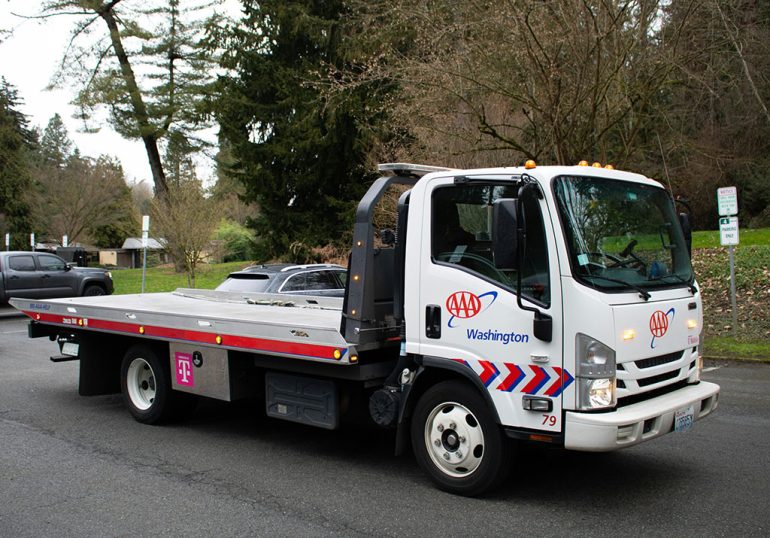
Flatbed carriers were once easy to think of simply as another category of recovery truck. Today, their ability to carry a vehicle with all four wheels completely off the road makes them particularly useful for many modern drivetrains.
That does not mean every recovery requires one.
Wheel-lift trucks remain highly effective for many cars and are especially useful in tight spaces where positioning a full rollback may be difficult. Heavy-duty wreckers serve a completely different role when dealing with buses, trucks or large commercial vehicles.
Looking across different types of tow truck equipment makes the specialization clear: carriers, recovery trucks and heavier configurations solve different problems rather than competing as one universal design.
The vehicle being recovered determines which solution makes sense.
Electronic Parking Brakes Can Turn a Simple Breakdown Into a Loading Problem
Mechanical parking brakes were relatively easy to understand during recovery. Modern electronic systems can be less cooperative when the vehicle has lost electrical power.
If a car is stuck in Park with an electronic brake applied, simply pulling it onto a flatbed can cause tire or drivetrain damage.
Some manufacturers provide manual release procedures, while others require a service or transport mode. In certain situations, dollies or tire skates may be necessary to move the vehicle safely before it can be loaded.
This is another reason modern towing increasingly depends on access to accurate vehicle-specific information. The physical truck may be the largest piece of equipment on scene, but knowing the correct release procedure can determine whether the recovery goes smoothly.
Collision-Damaged EVs Require Extra Awareness
A disabled electric vehicle and a collision-damaged electric vehicle are not necessarily the same recovery problem.
If a crash has compromised the battery enclosure or high-voltage components, additional safety considerations apply. Manufacturer emergency response guides may include specific instructions for transport, storage and monitoring.
Ford’s emergency guidance for the E-Transit, for example, warns tow operators about the potential for delayed fire involving a damaged lithium-ion battery.
This does not mean EVs are inherently unsafe to recover. It means the recovery process needs to account for a different set of hazards, making training and vehicle identification increasingly important as the number of electrified vehicles on the road grows.
Specialized Cars Demand Specialized Handling
Exotics provide another good example of why towing has become more vehicle-specific.
A high-performance car may combine very low clearance with expensive carbon-fiber aerodynamic components, large wheels, sensitive suspension and all-wheel drive. Even when the mechanical failure itself is minor, careless loading can cause expensive secondary damage.
Collectors and enthusiasts are particularly aware of this risk because even a small mistake during loading can damage bodywork, wheels, suspension components or aerodynamic parts.
For those vehicles, the quality of the recovery process is not simply measured by whether the car reaches its destination. It is measured by whether it arrives in exactly the same physical condition in which it was collected.
The Tow Operator Is Becoming a Vehicle Technician
Modern roadside recovery increasingly sits at the intersection of transportation and technical knowledge.
Operators still need the traditional skills: positioning the truck safely, rigging the vehicle correctly, operating the winch and securing the load. But they may also need to recognize drivetrain layouts, locate tow eyes, release electronic systems and understand model-specific transport procedures.
That trend will likely continue as electrification, software-controlled drivetrains and increasingly complex chassis systems make recovery procedures more vehicle-specific.
The tow truck itself remains a familiar sight on the roadside, but what has changed is the complexity of the vehicles it may be asked to carry.


