
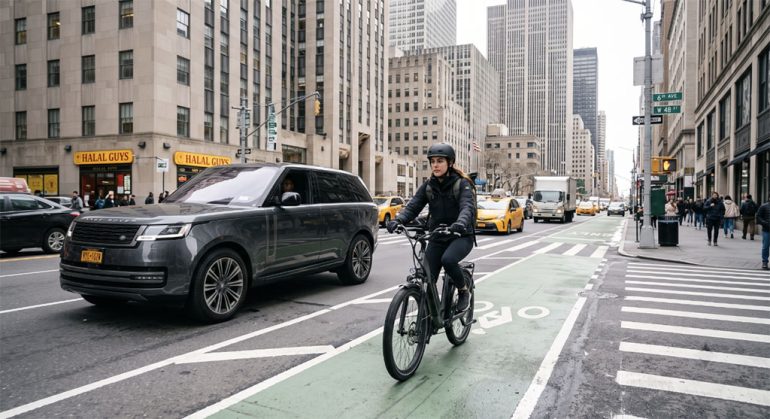
Car safety has been one of the great engineering success stories of the past three decades. Crumple zones, curtain airbags, stability control and automatic emergency braking have made the inside of a modern vehicle a remarkably survivable place.
New York City’s most recent figures show what happens when that progress meets a street where a growing share of traffic has no structure around it at all. The people being killed are increasingly not the people in cars.
Through late June of 2026, the city recorded 94 traffic fatalities, against 91 at the same point in 2025 and an average of 120 across 2021 through 2024.
Inside that roughly flat total, the composition shifted substantially. Pedestrian deaths fell to 46, down 13 percent from 53, which the city describes as the lowest level in recorded history apart from the first six months of 2020.
Motor vehicle occupant deaths came in at 16. At the same point in 2024 the figure was 29, and in 2023 it was 30.
Deaths among riders of e-bikes, stand-up scooters and mopeds were 18, up from 16 a year earlier. Within that, e-scooter rider deaths doubled from three to six. Traditional bicycles accounted for three.
Read those two lines together. In the first half of 2026, more people died riding small electric vehicles in New York City than died inside cars and trucks.
The injury data complicates any simple narrative, and it is worth being precise rather than tidy.
Rider injuries for e-bikes, scooters and mopeds were 1,036 as of the end of May, down 7 percent from 1,114 a year earlier and down 33 percent from the 1,539 recorded through the same date in 2023.
So injuries are falling while fatalities tick up. Fatality counts at this scale are volatile and a difference of two deaths is not a trend on its own. What is durable is the ratio: a shrinking pool of rider injuries is producing a share of deaths that now exceeds the entire occupant category.
None of this is mysterious to anyone who has thought about vehicle dynamics.
A collision between a 4,000 pound vehicle and a 70 pound e-bike distributes energy according to mass. The occupant of the heavier vehicle experiences a moderate deceleration inside a restraint system designed for it. The rider experiences the full delta as an unrestrained body separating from a machine.
Then there is the second impact, which is often the injurious one. The rider strikes the road, a parked car or a curb at whatever speed remains, with a helmet as the only engineered protection in the sequence.
The collapse in occupant deaths is not luck. Three decades of structural engineering, restraint development and, more recently, automatic emergency braking have compounded.
Those systems protect the people they were designed to protect. Almost none of them protect anyone outside the vehicle, and the pedestrian detection that does exist was calibrated against walking speeds rather than against a machine arriving at 25 mph from an unexpected angle.
The second factor is that electric assist raised the operating speed of two-wheeled traffic without changing anything about the rider’s protection. A bicycle lane designed around 12 mph traffic now carries vehicles moving at twice that, sharing space with pedestrians, delivery vehicles and turning cars.
Closing speeds at intersections rose accordingly, and a driver’s habit of judging an approaching cyclist’s speed was calibrated on a different machine.
The practical driving implication is about expectation rather than attitude.
Right hooks and left crosses are the dominant conflict, and both come from assuming an approaching two-wheeler is slower than it is. The gap that was comfortable against a conventional bicycle is not comfortable against an e-bike closing at 20 plus.
Door zones matter more for the same reason. So does the shoulder check before every right turn, because a vehicle that was not visible ten seconds ago can be beside you now.
Delivery riding compounds it. A large share of e-bike traffic in Manhattan is commercial, operating on a clock, at night, in weather, on routes chosen for speed rather than for the marked network. Those riders are where the injuries concentrate.
The city’s cycling data and its broader street safety program track these patterns across the network, and the concentration at intersections is consistent year over year.
Call for medical evaluation regardless of how the rider presents. Riders routinely stand up, decline help and discover a fracture hours later, and a refusal at the scene becomes an argument for months.
Document the roadway configuration as well as the vehicles: lane markings, where the bike lane runs, sight lines and signal phase. Those features explain the collision in a way that damage photographs do not.
Note whether the machine was pedal-assist or throttle-operated, and whether it had visible pedals at all. That single observation drives most of the classification question that follows.
Get the rider’s information and the class of machine, since the legal and insurance treatment of e-bikes, mopeds and scooters differs meaningfully by category. Anyone trying to sort out that tangle afterward, from either seat, is doing the kind of work Mark E. Seitelman Law Offices and similar practices handle routinely, because the category of the vehicle frequently determines which coverage responds at all.

Automotive Addicts Contributors are a collective of guest writers, industry professionals, and passionate enthusiasts who bring fresh perspectives to the Automotive Addicts platform. Focused on delivering timely news, in-depth reviews, and unique insights, these contributors help keep the site dynamic and engaging. Many use the platform to expand their reach and build credibility within the automotive media world, adding depth and variety to the content that drives the Automotive Addicts community.


