
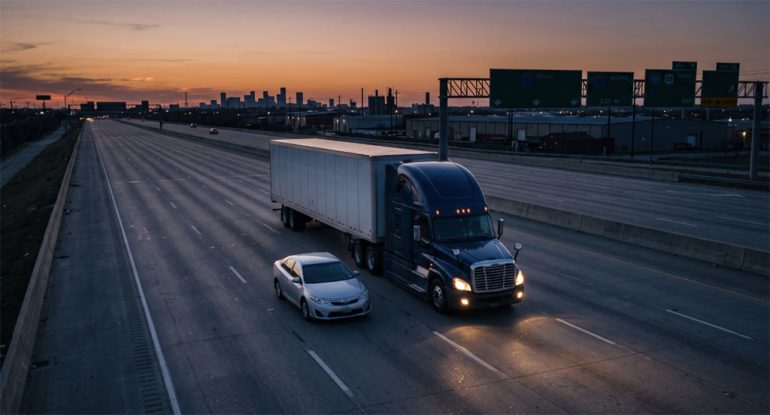
I-45 between Houston and the Gulf carries an extraordinary density of heavy commercial traffic. It feeds the port, the refineries and the distribution network that serves most of southeast Texas, which means passenger vehicles share the road with fully loaded tractor-trailers at speed, continuously.
A collision between two cars and a collision between a car and an 80,000-pound combination vehicle look like the same kind of event on a police report. As claims, they behave nothing alike, and the difference is almost entirely about evidence.
In an ordinary car wreck, most evidence is public or belongs to the people involved. In a truck case, the material that decides the outcome is generated by the trucking company and held on its servers.
Electronic logging device records. Dispatch and load assignment records. The bill of lading and weight tickets. Onboard telematics and fault codes. Driver qualification and training files. Maintenance and inspection history for the tractor and the trailer separately. Forward-facing and driver-facing camera footage. Post-collision drug and alcohol testing results.
None of that is in the crash report. Most of it has a defined retention period, and some of it has a very short one.
Federal regulation requires drivers to record duty status, and 49 CFR 395.8 sets out the requirements for records of duty status and the supporting documents a motor carrier must retain.
The electronic logging device requirements at 49 CFR 395.22 govern how carriers must configure and use these devices, including driver account management and the handling of unassigned driving time.
That last category is where cases are frequently won or lost. Driving time recorded to no particular driver is a question that demands an answer.
This is the operational difference that catches injured people off guard.
Large carriers and their insurers maintain rapid response protocols. Investigators, and sometimes accident reconstructionists, are on scene within hours, photographing, measuring, downloading the engine control module and interviewing witnesses.
By the time an injured driver has been discharged, the other side has a documented record built by professionals and a complete picture of what happened. The injured party typically has a handful of phone photographs taken by a bystander.
Retention periods run whether or not anyone has asked for the material. A formal spoliation letter identifying each category of evidence, sent within days, is what converts routine overwriting into a litigable failure.
Sent in month four, it preserves whatever happens to be left.
An 80,000 pound vehicle needs dramatically more stopping distance than a passenger car, which means the relevant driving decisions were made well before the point of impact.
That pushes the inquiry backward in time and away from the scene. Following distance, speed on the approach, and how long the driver had been behind the wheel become the real issues, and none of them are visible in the debris field.
A single tractor-trailer can involve half a dozen separate businesses, and they are frequently unrelated.
The driver. The motor carrier employing or contracting with the driver. The owner of the tractor, which may be a leasing entity. The owner of the trailer, which is often a different company again. The shipper. The company that loaded and secured the cargo. A maintenance contractor. A broker who arranged the freight.
Cargo that shifts because it was improperly secured is a loading problem, not a driving problem, and the entity responsible may never have touched the truck.
Texas regulates vehicle equipment under Chapter 547 of the Transportation Code, which sets out required equipment and standards for vehicles operated on the state’s highways.
Brake condition, tire condition, lighting and underride guard integrity are examined in every serious truck case, and maintenance records either support the carrier’s account or contradict it.
Many drivers are engaged as owner-operators rather than employees, and carriers routinely raise that status early as a reason the company is not responsible for the driver’s conduct.
It is rarely the end of the analysis. Federal operating authority, the lease arrangement, who controlled the route and schedule, and whose placard was on the door all bear on it. Treating the label as decisive concedes a point that has not been established.
A carrier’s own conduct can be at issue independently of the driver’s. Whether the qualification file was complete, whether the driving record was checked, whether prior violations were acted on, and whether training happened are all distinct questions.
Those live in the personnel file, which is another reason the preservation demand needs to be specific rather than general.
Commercial policies carry limits far above personal auto coverage. That has two consequences worth understanding before anyone signs anything.
Cases are defended harder, longer and with far greater resources than a comparable car wreck. Early settlement offers also arrive faster, before the injured person knows the extent of the injury, precisely because the exposure is large.
According to personal injury lawyer Matthew A. Rabin, a Partner and Managing Attorney handling pre-litigation and active litigation matters in RTRLAW’s Texas personal injury practice, the material that decides a truck case is usually in the carrier’s possession and governed by a retention clock that nobody outside the company is watching. That is the reason people injured on I-45 are urged to contact an attorney for truck crash cases in Houston within days rather than weeks, since a preservation demand sent late preserves only what survived.

Automotive Addicts Contributors are a collective of guest writers, industry professionals, and passionate enthusiasts who bring fresh perspectives to the Automotive Addicts platform. Focused on delivering timely news, in-depth reviews, and unique insights, these contributors help keep the site dynamic and engaging. Many use the platform to expand their reach and build credibility within the automotive media world, adding depth and variety to the content that drives the Automotive Addicts community.


