
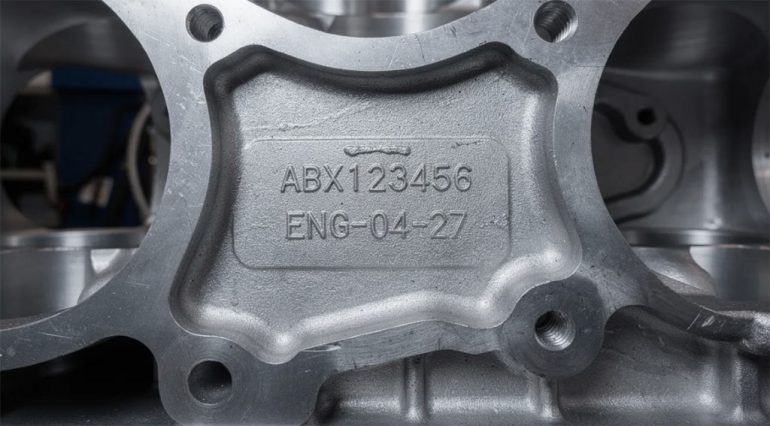
In 2026, the automotive supply chain spans more countries, more tiers, and more component types than ever before. Electrification, software-defined vehicles, and tightening global regulations are forcing every link in that chain to prove exactly where a part came from, when it was made, and what happened to it along the way. Laser marking creates permanent identification marks on automotive components, linking every critical part to its digital record through serial numbers and data matrix codes.
Here’s why permanent marking is non-negotiable in automotive manufacturing today:
At HiSpeed Laser, we focus on laser technology as the dominant method for creating these marks-replacing the fragility of labels and ink with permanence built into the material’s surface. Consider this: an engine block stamped with a data matrix code at a Tier-1 plant in 2024 must still be perfectly readable during a recall investigation in 2034. That’s the standard permanent marking has to meet.
Permanent identification marks are direct part marking (DPM) embedded in the component surface itself-not printed on packaging, not stuck on with a label. Laser marking enhances traceability throughout the automotive supply chain by making every part individually identifiable from raw material to end-of-life recycling.
Concrete data types typically encoded include:
Data matrix codes can be laser marked for compact information storage, packing dozens of characters into an area as small as 2–3 mm². Laser marking is also used for engraving vehicle identification numbers directly onto chassis and powertrain components.
These marks support full lifecycle traceability. From forging or casting through machining, assembly, and years of vehicle service, each scan at each station writes process data into the part’s digital history. Permanent marks include serial numbers, part numbers, and data matrix codes that tie directly into MES and ERP traceability systems. Unique identifiers enable tracking of parts throughout production and across the wider supply chain.
The same principles apply in aerospace and automotive industries, as well as in medical device manufacturing-but the examples throughout this article focus on automotive applications.
In contrast, removable labels or ink can be lost, smeared, or replaced. Once a label is gone, the traceability chain breaks.
OEMs and suppliers mix several marking methods depending on the material, production volume, required durability, and downstream processes like painting or shot blasting. Marking methods must align with factors like material compatibility and production speed.
Main permanent methods:
Semi-permanent and ancillary methods:
HiSpeed Laser specializes in laser marking systems for permanent marking, while we recognize that other marking methods still serve specific applications.
Laser marking alters the surface of materials using a focused beam of light without contact-no inks, no consumables, no physical tooling that wears out. Permanence comes from modifying the material itself.
Here’s how the different laser marking mechanisms work:
Laser marking is a non-contact process that protects component integrity-critical when marking delicate sensor housings or precision-machined surfaces. Laser engraving and etching produce deep and high-contrast marks suitable for complex identification patterns on everything from VINs to micro-sized data matrix codes.
The production process is digitally controlled: CAD or database input feeds serial/code data to a galvo scanning head, which directs the beam across the part with micron-level precision. Laser marking creates permanent serial numbers on automotive components and can produce QR codes for digital traceability in vehicles.
For high-volume automotive production lines, modern fiber laser systems mark multiple data matrix codes per second, keeping pace with takt time requirements.
The contrast between direct part marking and labels or ink is stark in real-world automotive environments.
Consider a specific scenario: a QR label on a brake caliper box gets damaged during shipping. The caliper reaches the assembly line with no readable ID. Traceability is broken. By contrast, a laser-etched data matrix on the caliper body itself travels with the part through assembly, vehicle service, and even a crash investigation years later.
Graffiti or non-permanent marks are generally not suitable for automotive parts. Laser marking creates permanent, tamper-proof identifiers on components, and laser markings withstand harsh environmental conditions without fading. Direct part marking ensures traceability and quality control in automotive manufacturing, which is why by mid-2026, most major automotive manufacturers require machine-readable direct marks on safety-critical parts. Laser marking provides tamper-proof vehicle identification numbers that resist alteration or removal.
Where labels and ink still work:
The data encoded in permanent identification marks on automotive components typically includes:
Data matrix codes store more information than traditional barcodes, making them the standard for dense encoding on small parts like ABS sensors, fuel injectors, and printed circuit boards. Manufacturers must adhere to strict industry standards for 2D data matrix codes, including ECC200 per ISO/IEC 16022. QR codes enable real-time tracking in automotive manufacturing, while barcodes facilitate automated inventory management in production lines.
At each production station, the code is scanned: process parameters, inspection results, machine identity, and operator ID are all written into the part’s digital history. This is what makes recall management surgical rather than blunt. Instead of recalling an entire model year, a manufacturer can isolate parts produced between 2:00 and 3:00 AM on a specific date from a single supplier batch-and mark serial numbers that tie directly to those records. Data matrix codes enhance traceability in manufacturing processes at every stage.
Material dictates both the marking method and the laser type. Surface finish, coatings, pigments, and additives all influence absorption, contrast, and durability-so what works on a raw coupon often behaves differently on a production part.
Metals (steel, stainless, cast iron, aluminum, copper, alloys):
Plastics and composites (PA, PBT, PC, PPS, epoxy):
Glass and ceramics (windscreens, camera lens housings, spark plugs):
Elastomers (seals, hoses):
Laser marking allows intricate designs on automotive interior elements, and premium brands use laser marking for refined appearances in vehicles-from backlit switch icons to decorative trim patterns. Custom laser markings can personalize limited-edition automotive models with unique serial graphics.
HiSpeed Laser conducts application testing on actual customer parts because coatings, finishes, and additives affect marking results in ways that cannot be predicted from material data sheets alone.
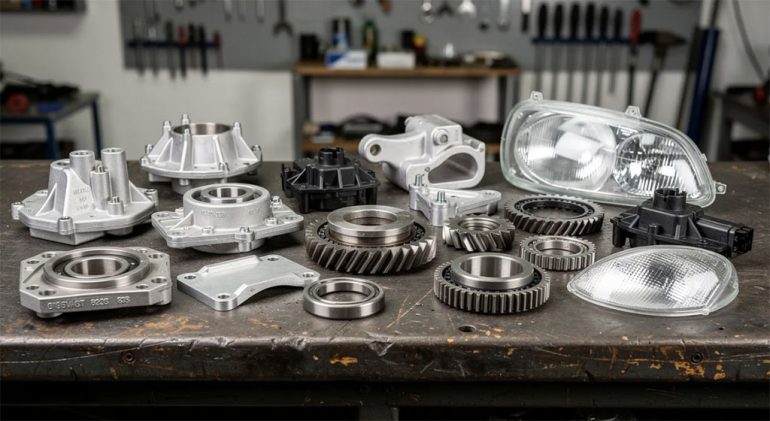
Modern vehicles-ICE, hybrid, and EV-contain thousands of marked parts sourced from dozens of suppliers. Many automotive components carry identification marks that must remain readable for the vehicle’s entire lifecycle.
Permanent marking underpins conformance with IATF 16949:2016 and the customer-specific requirements issued by every major OEM. Without readable, verifiable marks, a supplier cannot demonstrate the traceability chain that auditors expect-and non-conformance can mean lost business. Laser marking enhances compliance with industry regulations by producing marks that meet verification grade requirements.
Concrete mandated marking examples include:
Regulatory compliance extends beyond automotive. Similarities exist with UDI requirements for medical devices (where surgical instruments carry permanent laser marks) and serialization rules in the electronics industry. The AS9132 standard defines Data Matrix quality requirements for metallic aerospace parts, and many automotive suppliers adopt comparable verification grades.
Durable, readable marks simplify audits, PPAP documentation, and field-failure investigations. HiSpeed Laser systems produce marks with contrast and quality that meet standard verification grades, including AIM DPM grades used across aerospace and automotive industries.
Permanent identification marks act as anchors for end-to-end traceability across multi-tier supply chains. Without them, a digital traceability system has no physical link to the part it’s supposed to track.
Imagine this scenario: in 2028, a brake hose failure in the field is traced via its data matrix code back to a specific raw material batch from a specific supplier shift. The manufacturer isolates the affected lot within hours-not weeks-and targets only the vehicles that received those parts.
This is not hypothetical. The Catena-X traceability network demonstrated that cross-tier data sharing, built on identifiable marks and digital records, enabled an OEM to reduce a potential recall from 1.4 million vehicles to just 14 affected units. That kind of precision is impossible without reliable identification marks on every component.
Robust traceability systems also protect against counterfeit automotive parts entering the supply chain-especially for high-value vehicle components like turbochargers, ADAS sensors, and EV battery packs. Integrating laser-marked data matrix codes with supply chain platforms enables quick authentication at workshops and dealerships, letting technicians verify whether a part is genuine with a single scan.
Permanent identification marks must survive extreme environments including heat and chemicals. When marks degrade, the entire traceability system is compromised. Laser markings on properly specified parts remain readable across the part’s entire life cycle.
Selecting the right marking solution follows a step-by-step decision logic:
For laser type selection:
Laser marking integrates easily into automated production lines, making it the default for high volume production lines with tight cycle times. Early application testing on real components-not flat coupons-is essential to validate contrast, readability after coating, and marking process cycle time.
HiSpeed Laser offers OEM/ODM customization so the marking solution fits specific line speed, part size, and automation requirements.
Typical integration patterns for automotive marking include:
Vision systems, fixtures, and sensors ensure correct part orientation and focus before the marking process begins. Automated systems eliminate human error in code placement and content.
Connectivity matters: laser marking systems link to MES, ERP, PLCs, and quality databases for automatic serial number assignment, production data logging, and real-time quality control feedback. Laser marking integrates with automated production lines for traceability, and can be integrated into automated production lines for efficiency without disrupting existing workflows.
Safety and compliance features include Class 1 enclosures, light curtains, and interlocks suitable for 24/7 automotive plant operation. HiSpeed Laser designs marking systems to minimize takt time impact, often marking in parallel with other operations like leak testing or torqueing, so operational efficiency stays high.
Marks on automotive parts must survive conditions that destroy most other identification methods:
OEMs and Tier suppliers validate mark durability through salt spray tests (500+ hours), chemical immersion, thermal cycling, and on-line verification with code readers. Laser marking withstands harsh conditions, ensuring traceability across the part’s entire lifecycle.
There’s an important distinction between shallow marks and deep marks. Surface-level annealing works for interior trim or protected electronics housings, but engine blocks or chassis parts that undergo shot blasting or machining after marking need laser engraving to depths of 300 µm or more. Other marking methods like dot peen can also achieve depth, but with less control over code density and resolution.
Process control-laser power, speed, focus, and pulse parameters-ensures consistent code quality across millions of parts on the production line. Variation in any parameter can degrade contrast or readability.
Quality control on critical automotive components should include:
HiSpeed Laser is a Dongguan-based manufacturer of industrial laser equipment serving automotive companies, electronics manufacturers, and medical device producers worldwide.
Relevant product families include:
OEM/ODM capabilities:
HiSpeed Laser provides global after-sales support, spare parts availability, and remote diagnostics tailored to multi-plant automotive customers where downtime is measured in thousands of dollars per minute.
Cross-industry advantages are real: laser technology proven on medical devices and electronics-where tolerances for marking delicate and sensitive components are extreme-translates directly to the precision demands of EV cooling plates, ADAS sensor housings, and battery management systems.
If you’re planning to implement or upgrade permanent marking in your facility, here’s a practical roadmap:
Cross-functional involvement is critical. Quality engineers, production engineering, IT (for MES/ERP data integration), and purchasing (for lifecycle cost analysis) should all participate from the start.
Common pitfalls to avoid:
If you’re evaluating marking equipment for automotive or related applications, HiSpeed Laser offers application testing, system design consultation, and OEM/ODM solutions sized to your production requirements. Reach out to discuss your specific parts, materials, and traceability goals.
Permanent marking is now fundamental to safety, regulatory compliance, and supply chain resilience in automotive manufacturing. Laser marking systems provide a scalable, precise, and durable solution for marking automotive parts at volume-connecting every component to its digital record from the casting floor to the service bay decades later. The connection between robust marking, faster recall management, protection against counterfeit automotive parts, and stronger brand reputation is direct and measurable.
As EVs, autonomous driving, and stricter global standards continue to reshape the industry, the quality of permanent identification marks will matter even more. HiSpeed Laser intends to be a long-term partner in that transition.
Key takeaways:

Automotive Addicts Contributors are a collective of guest writers, industry professionals, and passionate enthusiasts who bring fresh perspectives to the Automotive Addicts platform. Focused on delivering timely news, in-depth reviews, and unique insights, these contributors help keep the site dynamic and engaging. Many use the platform to expand their reach and build credibility within the automotive media world, adding depth and variety to the content that drives the Automotive Addicts community.


