
Car enthusiasts often spend hours obsessing over 0-60 times, battery range, and torque vectoring. Yet, a crucial component of the EV ecosystem is frequently an afterthought: the “box” on the garage wall.
While the vehicle itself is a marvel of modern engineering, the infrastructure powering it is often taken for granted. This is a dangerous oversight. If your charging hardware isn’t up to standard, your high-performance EV is nothing more than a static display piece—or worse, a fire hazard waiting to happen. To truly protect your investment and your home, you must understand the electromechanical reality of Level 2 charging.
The Hardware Behind the Charge
Many consumers view a wallbox charger simply as a fancy extension cord. In reality, it is a sophisticated piece of safety equipment known as EVSE (Electric Vehicle Supply Equipment). It serves as the primary gateway between the raw power of the grid and the sensitive battery management system (BMS) of your car.
Before drilling holes in your garage wall, you must scrutinize the source of your equipment. A robust charging setup relies heavily on the quality of its internal protective components—switches, breakers, and leakage detectors—rather than just the outer aesthetic. Industry specialists like BENY design these critical EV charger components to withstand extreme electrical stress, ensuring that the power flowing into your vehicle is clean, stable, and safe from surges. Beyond the wallbox itself, the cable-to-vehicle interface is evolving too, auto-aligning hardware like a Magnetic Connector is starting to replace traditional friction-fit couplers, reducing port wear and making daily plug-in faster.
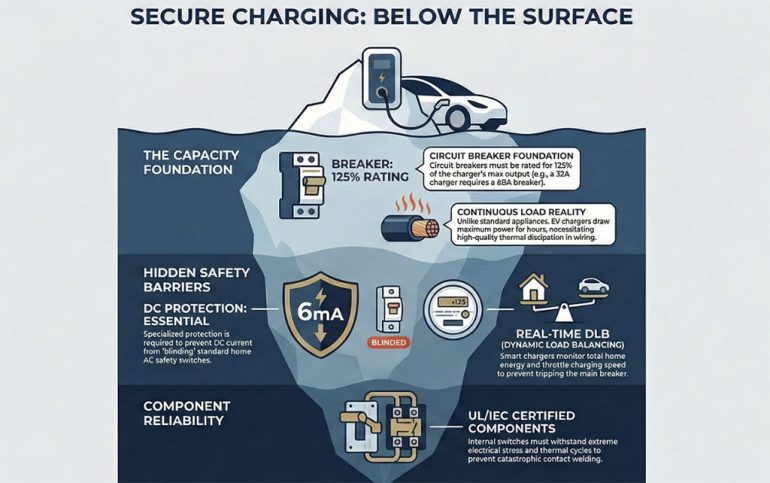
Prioritizing components that meet UL or IEC standards ensures that the hardware can handle the thermal cycles associated with daily charging without welding contacts or failing catastrophically.
Analyzing Your Home’s Electrical Capacity
The most common mistake in DIY charging setups is failing to account for “Continuous Load.” unlike an electric dryer or oven that cycles on and off, an EV charger draws maximum power for hours at a time.
The 125% Rule Electrical codes (like the NEC in the US) dictate that circuit breakers and wiring for continuous loads must be rated for 125% of the device’s maximum output.
- 32A Charger: Requires a 40A breaker.
- 40A Charger: Requires a 50A breaker.
- 48A Charger: Requires a 60A breaker.
If you are retrofitting a charger into an older home, simply swapping an outlet is rarely sufficient. You must evaluate the thermal dissipation of the wiring and the main service panel’s remaining capacity.
The Danger of DC Leakage
One of the more complex risks in EV charging is the conversion of Alternating Current (AC) from the grid to Direct Current (DC) stored in the battery. If a fault occurs in the vehicle’s onboard charger, DC current can “leak” back into the home’s AC wiring.
Why is this dangerous? Standard home safety switches (Type A RCDs) are designed to detect AC faults. If smooth DC leakage current exceeds 6mA, it can magnetically saturate the core of a standard RCD, effectively “blinding” it. In this state, the safety switch will not trip even if a lethal AC shock occurs elsewhere in the house.
The risk is not theoretical. As highlighted in the Alternative Fuels Data Center (AFDC), while EVs require less mechanical upkeep, their high-voltage electrical systems demand rigorous safety checks and certified infrastructure to prevent hazards. This is why specifically rated protection against DC fault current (Type B RCD or integrated 6mA DC detection) is non-negotiable for modern EV installations.
Future-Proofing with Smart Tech
Safety is not just about preventing fires; it is about grid management. As households add more electric loads, “dumb” chargers become liabilities. Modern setups should utilize Dynamic Load Balancing (DLB).
- How it works: The charger monitors total home energy usage in real-time. If you turn on the AC and the electric stove, the charger automatically throttles down the EV charging speed to prevent tripping the main breaker.
- V2H (Vehicle-to-Home): Looking forward, bidirectional chargers will allow your EV to act as a backup battery during outages, but this requires even more rigorous isolation switches to prevent back-feeding the grid during repairs.
Key Takeaways
| Area | Key Takeaway | Impact/Data |
| Hardware | Mandate UL/IEC certified EVSE components | Prevents contact welding and fire |
| Capacity | Enforce “125% Rule” for continuous load wiring | 48A charger requires 60A breaker |
| Safety | Install Type B RCD or 6mA DC detection | DC backflow blinds standard safety switches |
| Grid | Implement Dynamic Load Balancing (DLB) | Prevents main breaker trips during peak use |
Conclusion
Owning a high-performance EV requires a high-performance mindset regarding infrastructure. Do not let the charger be the weak link in your automotive passion. By prioritizing component quality, understanding load capacity, and mitigating DC leakage risks, you ensure that your vehicle performs at its peak—safely.


