
For professional restorers and project car owners, the greatest challenge often isn’t the mechanical labor—it’s the logistics. It is the hunt for “Unobtanium”: those specific trim pieces, bezels, or engine components that have seemingly vanished from existence.
While the romance of the restoration hobby often centers on bringing an engine back to life, the reality is frequently stalled by a single missing bracket or a cracked lens. However, the industry is undergoing a massive shift. We are moving away from the scarcity mindset of the 20th century into an era where digital manufacturing ensures that nothing stays extinct forever.
The Shift: Why Scavenging is No Longer Viable
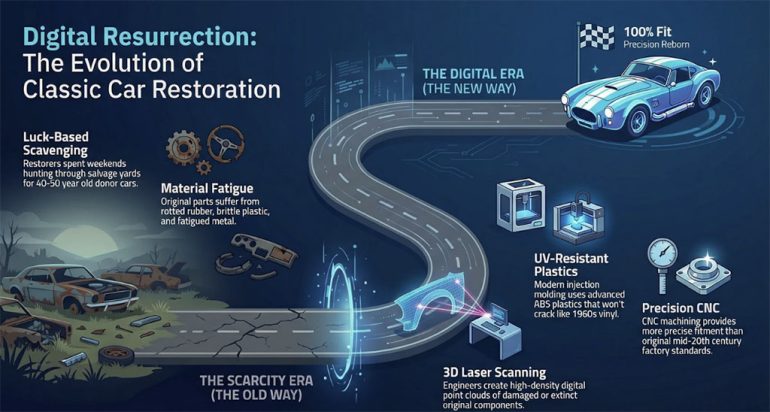
Historically, restoring a vintage vehicle meant spending weekends crawling through salvage yards, hoping to find a donor car that wasn’t already picked clean or returned to the earth via rust. This “junkyard hunting” method is becoming increasingly inefficient. Parts found in scrap yards are often 40 to 50 years old; rubber is rotted, plastic is brittle, and metal is fatigued.
For decades, restorers relied on luck to find parts. But relying on luck is not a scalable strategy for a restoration shop. Today, the supply chain has evolved. Specialized manufacturers have stepped in to bridge the gap between extinction and availability. Companies like Sunwayautoparts now utilize advanced reverse engineering to mass-produce hard-to-find components—from vintage lighting assemblies to engine parts—ensuring that restorers can buy brand-new, OE-quality units instead of refurbishing rusted scrap.
This shift allows builders to focus on assembly and finish, rather than wasting billable hours searching for salvageable components.
The Tech Behind the Resurrection: Reverse Engineering
The resurgence of high-quality classic parts is driven by technology that didn’t exist when these cars rolled off the assembly line. Modern aftermarket manufacturing relies heavily on 3D Scanning and Reverse Engineering.
Instead of working from lost or destroyed original blueprints (Blueprints), engineers use laser scanners to create a high-density point cloud of an original part—even one that is damaged.
- CAD Data Reconstruction: Engineers digitally repair the damage in the 3D model, ensuring mounting points align perfectly.
- Material Science Upgrades: While the part looks “Period-correct,” the materials are modern. For example, modern Injection Molding uses UV-resistant ABS plastics that won’t chalk or crack like the original 1960s vinyl or early plastics.
Quality Control: Reproductions vs. Originals (NOS)
There is a long-standing debate in the community regarding New Old Stock (NOS) versus Reproductions. While NOS parts carry the allure of being “factory original,” they also carry the burden of shelf life. A rubber seal sitting on a shelf for 40 years has likely degraded, even in packaging.
Conversely, modern high-end reproductions often feature superior tolerances. Because modern CNC machining and tooling are more precise than the mass-production standards of the mid-20th century, a well-made reproduction part often fits better than the original factory component ever did. This consistency is vital for shops managing multiple builds; they need parts that fit the first time, every time.
Future-Proofing Your Investment
The value of a classic vehicle is intrinsically tied to its completeness. A vehicle missing unique trim or functional components is simply an unfinished project, and its market value reflects that.
Securing a reliable parts source effectively allows you to skip the hardest parts of the restoration process. As detailed in Hagerty‘s guide on the 5 levels of parts finding, moving from “searching blindly” to “having a reliable supplier” is the ultimate goal for any builder. Without the aftermarket support utilizing modern tech, many of these vehicles would simply remain static lawn ornaments rather than functional machines.
By embracing modern manufacturing solutions, we aren’t just fixing cars; we are preserving automotive history for the next generation of drivers.
Key Takeaways
| Area | Key Takeaway | Impact/Data |
| Legacy Sourcing | Scavenging is inefficient; relies on “luck,” not strategy. | Stock is 40-50 years old; typically rotted or fatigued. |
| Technology | 3D scanning/CAD replaces physical blueprints. | Reconstructs OE-quality units even from damaged samples. |
| Quality | Modern reproductions outperform “New Old Stock” (NOS). | Superior tolerances via CNC; modern UV-resistant materials. |
| Operations | Shift focus from searching to building. | Maximizes billable hours; ensures project completeness/value. |
Conclusion: The Road Ahead for Restoration
The era of the “unfinishable” project car is coming to an end. We are witnessing a fundamental change in the restoration landscape, where the barrier to entry is no longer the scarcity of parts, but simply the will to build.
As the industry pivots from scavenging to sourcing, the definition of authenticity is evolving. It is no longer about preserving the decay of old materials, but about preserving the spirit of the machine using the best technology available today. By leveraging reverse engineering and modern manufacturing partners, restorers can ensure that automotive history isn’t just remembered in static photographs, but experienced where it belongs: on the open road.


