
Modern vehicles have fundamentally evolved from purely mechanical machines into highly sophisticated, automated ecosystems. For luxury SUVs and modern electric vehicles (EVs), the defining characteristic of premium quality is no longer just horsepower; it is seamless, automated motion.
From deployable door handles to active suspension adjustments, modern automotive design relies less on manual user effort and heavily on hidden mechanical components. This invisible orchestration of movement defines the modern driving experience.
The Hidden Motors Behind Modern Automotive Luxury
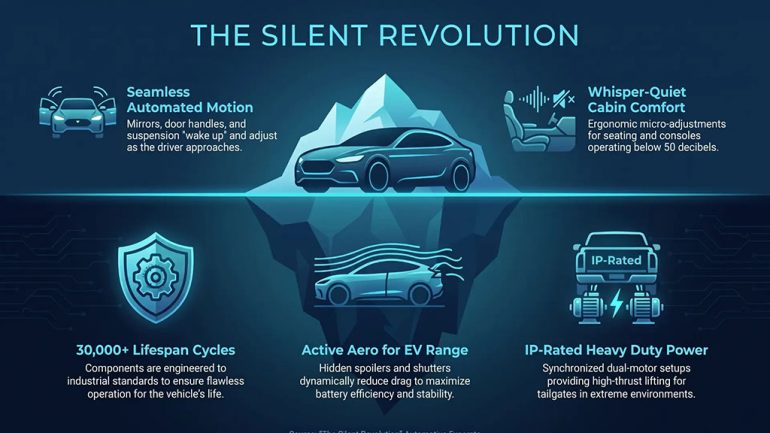
When a driver approaches a premium EV, the vehicle often “wakes up.” Mirrors fold out, door handles present themselves, and the suspension lowers to grant easier access. Behind these seemingly magical interactions are compact, highly durable motorized mechanisms.
These systems must operate invisibly and consistently in extreme environmental conditions, ranging from freezing temperatures to scorching desert heat. This demands a level of engineering precision that goes far beyond standard automotive manufacturing.
The Engineering Standard: Reliability Meets Silence
Automotive engineers are increasingly borrowing specifications from the medical and heavy-duty manufacturing sectors. Today’s luxury vehicle owners expect automated components to work flawlessly for the vehicle’s entire lifespan.
To achieve this, components like power liftgates and adjustable seating must meet extreme benchmarks—such as sustaining a 30,000-cycle lifespan while operating at whisper-quiet levels below 50 decibels.
These stringent metrics are directly inherited from the precision Hoodland used in heavy-duty and smart-home applications. This cross-industry standard ensures that the luxury feel isn’t compromised by mechanical wear or intrusive motor noise.
Key Applications: Where Motion Control is Changing the Game
The integration of automated motion control extends far beyond simple door locks. Today, specialized mechanical components are deployed across the entire chassis to enhance both utility and comfort.
Power Tailgates and Tonneau Covers in Modern Trucks
Heavy pickup trucks and large SUVs require robust solutions to handle substantial physical loads seamlessly. Manual operation of heavy truck beds is rapidly becoming obsolete.
Automakers are utilizing synchronized lifting columns and heavy-duty actuators to automate these high-stress areas. The engineering requirements for these specific applications include:
- High Load Capacity: Generating enough dynamic thrust to lift heavy fiberglass or metal tonneau covers.
- IP-Rated Motors: Ensuring total protection against dust, water, and road salt ingress.
- Synchronized Motion: Utilizing dual-motor setups equipped with Hall effect sensors to prevent binding during operation.
Whisper-Quiet Cabin Comfort Adjustments
Inside the cabin, the focus shifts from raw power to absolute precision and discretion. Luxury seating now incorporates micro-adjustments for lumbar support, side bolsters, and even extending calf rests.
Furthermore, automated retractable center consoles and articulating infotainment screens rely on miniature actuators. These motors must operate with zero perceptible vibration, ensuring the cabin remains a serene environment while executing complex ergonomic adjustments.
Active Aerodynamics: The Secret Weapon for EV Range
Efficiency is the ultimate currency in the EV era, and static designs can only go so far. To maximize battery efficiency, automakers are turning to dynamic exterior adjustments that respond in real-time to driving conditions.
By utilizing linear motion technology to deploy rear spoilers or adjust active grille shutters at highway speeds, vehicles can dynamically alter their shape to slice through the air with minimal resistance.
According to the foundational principles of automotive aerodynamics, lowering the drag coefficient even fractionally yields measurable gains in both highway range and high-speed stability. This proves that moving parts are just as critical to overall efficiency as the battery itself.
Key Takeaways
| Area | Key Takeaway | Impact/Data |
| Purity | Standardize medical-grade specs | Sustains 30k+ cycles |
| Silence | Minimize cabin motor noise | Operates below 50 dB |
| Sync | Deploy Hall effect sensors | Prevents dual-motor binding |
| Range | Integrate active aero spoilers | Lowers drag coefficient |
| Robust | Enforce IP-rated motors | Blocks dust, water, salt |
The Future of Vehicle Automation Components
As the automotive industry pushes further into full electrification and autonomous driving, the demand for reliable automated components will only multiply. Vehicles will increasingly feature adaptable interiors that transform based on whether the car is being driven or operating autonomously.
The electrification of vehicles requires robust, compact, and highly intelligent linear motion solutions. By adopting the strict tolerances of industrial-grade engineering, automakers are ensuring that the future of mobility is not only cleaner and faster but remarkably refined.


