

The Kia Sorento is a three-row midsize SUV available in three distinct powertrain configurations: a conventional gasoline model, a self-charging hybrid, and a plug-in hybrid electric vehicle (PHEV). With ten gas trims, four hybrid trims, and one PHEV trim across a price range of $32,590 to $53,890 before destination, the Sorento lineup covers more ground than almost any other three-row competitor. The 2027 model is largely a carryover update following the 2025 mid-cycle refresh that restyled the exterior and upgraded the interior; changes for 2027 are focused on color palette adjustments and trim content refinements. Here is what dealers paid across all three powertrain families and what you should be targeting.
The gasoline Sorento spans ten configurations across five named trim levels. Lower trims use a naturally aspirated 2.5-liter four-cylinder; upper trims step up to a turbocharged 2.5-liter four-cylinder. The LX and S trims are available in front-wheel drive and AWD; EX adds FWD and AWD options; SX and X-Line configurations are AWD only. Prices below exclude the $1,495 destination charge.
| Trim | MSRP | Invoice | Gap |
|---|---|---|---|
| LX FWD | $32,590 | $31,776 | $814 |
| S FWD | $35,490 | $34,602 | $888 |
| S AWD | $37,490 | $36,552 | $938 |
| EX FWD | $38,690 | $37,722 | $968 |
| EX AWD | $40,190 | $39,186 | $1,004 |
| SX FWD | $42,490 | $41,002 | $1,488 |
| X-Line EX AWD | $42,990 | $41,916 | $1,074 |
| X-Line SX AWD | $44,290 | $42,739 | $1,551 |
| X-Line SX-Prestige AWD | $46,990 | $45,346 | $1,644 |
| X-Pro SX-Prestige AWD | $47,990 | $46,311 | $1,679 |
Invoice figures sourced from AutoFinder. Some pricing sources may list different MSRPs. Always verify the current MSRP on the window sticker before making an offer.
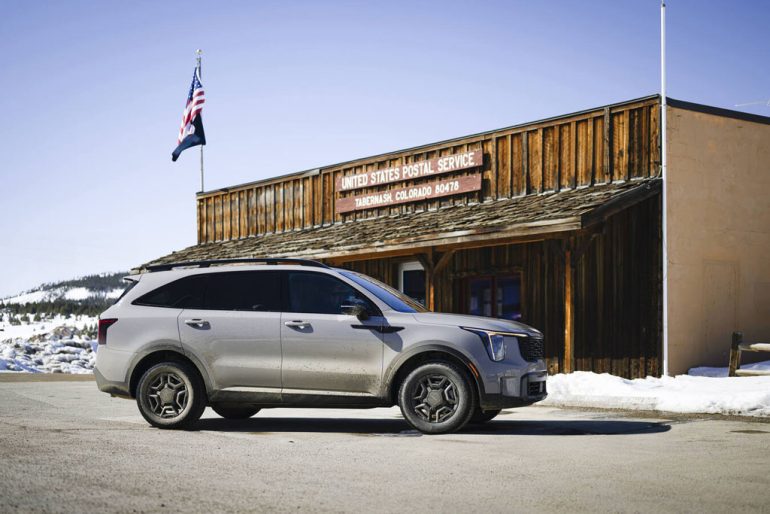
The Sorento Hybrid uses a 1.6-liter turbocharged four-cylinder paired with a hybrid drive system and shares the same body and three-row seating as the gas model. For 2027, the Hybrid lineup gains a new X-Line EX trim with a darker, more aggressive appearance package, and a head-up display becomes standard on the SX-Prestige. The Hybrid adds a distinctive “HEV” badge to the rear tailgate. Prices below exclude the $1,495 destination charge.
| Trim | MSRP | Invoice | Gap |
|---|---|---|---|
| EX FWD | $39,090 | $38,112 | $978 |
| EX AWD | $40,890 | $39,867 | $1,023 |
| X-Line EX AWD | $43,090 | $42,012 | $1,078 |
| X-Line SX-Prestige AWD | $47,590 | $45,925 | $1,665 |
Invoice figures sourced from AutoFinder. Some pricing sources may list different MSRPs. Always verify the current MSRP on the window sticker before making an offer.
The Sorento PHEV is now available in a single trim for 2027. Kia consolidated the PHEV lineup from two trims down to one, retaining only the X-Line SX-Prestige AWD configuration. The PHEV gains a standard head-up display and X-Line embossing on the front seatbacks for 2027. The $7,500 federal plug-in hybrid tax credit that previously applied to the Sorento PHEV has been eliminated under the One Big Beautiful Bill Act, signed July 4, 2025, and effective for purchases after September 30, 2025. Buyers should factor the full purchase price into their calculations rather than assuming any federal tax credit offset. Prices below exclude the $1,495 destination charge.
| Trim | MSRP | Invoice | Gap |
|---|---|---|---|
| X-Line SX-Prestige AWD | $53,890 | $52,003 | $1,887 |
Invoice figures sourced from AutoFinder. Some pricing sources may list different MSRPs. Always verify the current MSRP on the window sticker before making an offer.
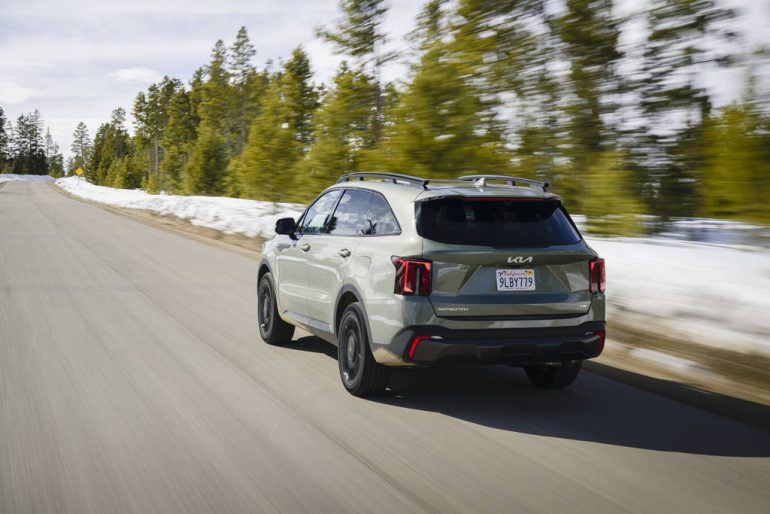
The destination and freight charge on all 2027 Kia Sorento configurations is $1,495. With destination included, the gas Sorento range runs from $34,085 on the LX FWD to $49,485 on the X-Pro SX-Prestige AWD. The Hybrid runs from $40,585 on the EX FWD to $49,085 on the X-Line SX-Prestige AWD. The PHEV X-Line SX-Prestige AWD comes to $55,385 with destination.
The 2027 Sorento is a minor update following the more substantial 2025 mid-cycle refresh. Changes across all three powertrain families include:
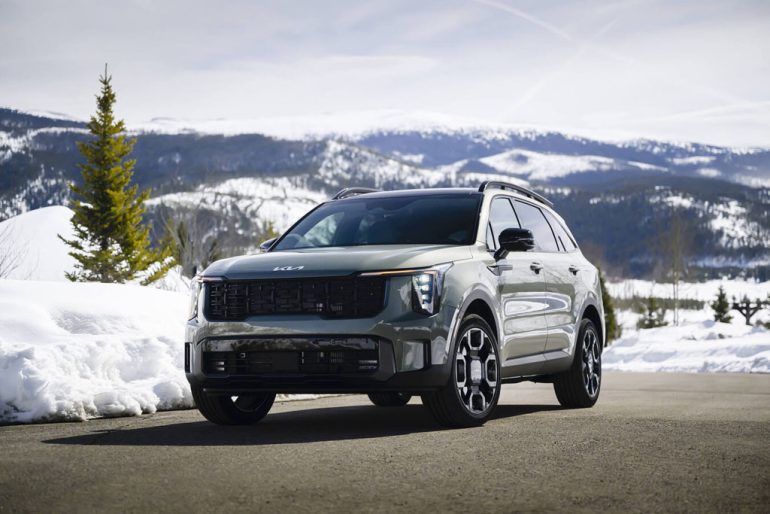
The gasoline Sorento uses two different engines depending on trim level. The LX and S are powered by a 2.5-liter naturally aspirated four-cylinder producing 191 horsepower and 181 lb-ft of torque, paired to an 8-speed automatic transmission. The EX, SX, X-Line, and X-Pro trims all step up to a 2.5-liter turbocharged four-cylinder producing 281 horsepower and 311 lb-ft of torque, paired to an 8-speed dual-clutch transmission. All-wheel drive is available on S and EX and is standard on the SX and X-Line configurations.
EPA fuel economy (gas, naturally aspirated): 23 city / 31 highway / 26 combined mpg (FWD); 23 city / 28 highway / 25 combined mpg (AWD).
EPA fuel economy (gas, turbocharged): 20 city / 29 highway / 23 combined mpg (FWD); 20 city / 27 highway / 23 combined mpg (AWD).
Towing: 3,500 lbs when properly equipped with the tow package. The Sorento’s tow rating is adequate for a small to medium boat or utility trailer and is competitive with the Toyota Venza and Honda Pilot in the class.
Seating: The Sorento seats up to seven passengers in a three-row configuration (2-3-2 layout). The third row is best suited to children and occasional adult passengers due to its dimensions.
Cargo volume: 12.6 cubic feet behind the third row, 38.5 cubic feet with the third row folded, and 75.5 cubic feet with both rear rows folded.
Dimensions: 188.0 inches overall length, 74.4 inches width, 66.3 inches height, 110.4-inch wheelbase.
Fuel tank: 17.7 gallons on FWD configurations; 18.8 gallons on AWD configurations.
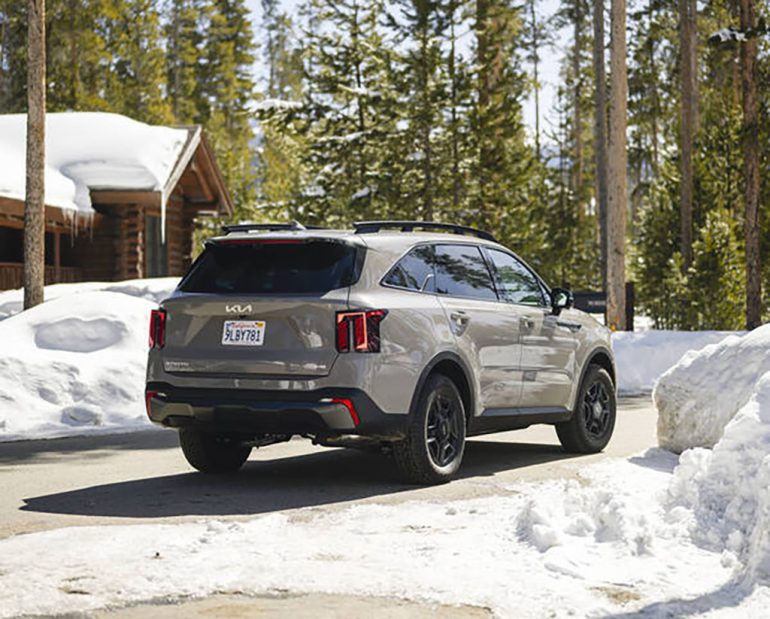
The Sorento Hybrid uses a 1.6-liter turbocharged four-cylinder paired with an electric motor and a six-speed wet-clutch automatic transmission. The powertrain is unchanged from 2026 and carries over from the mid-cycle refresh. Combined system output is approximately 227 horsepower. FWD is available on the EX trim; AWD is available on EX and is standard on both X-Line configurations.
EPA fuel economy (Hybrid, FWD): Approximately 39 city / 35 highway / 38 combined mpg. The Sorento Hybrid’s fuel economy makes it one of the most efficient three-row midsize SUVs available without plugging in.
EPA fuel economy (Hybrid, AWD): Approximately 38 city / 34 highway / 36 combined mpg.
Towing: 3,500 lbs when properly equipped, matching the gas model’s rating.
Seating, cargo, and dimensions: Identical to the gas Sorento. The Hybrid uses the same body structure, interior, and cargo layout as the conventional model. The hybrid drive system is packaged under the floor and does not reduce cargo or third-row dimensions relative to the gas Sorento.
The Sorento PHEV uses a 1.6-liter turbocharged four-cylinder paired with a larger electric motor and a 13.8-kWh battery pack, driving all four wheels through a six-speed transmission. Combined system output is 268 horsepower and 270 lb-ft of torque. AWD is standard and is the only available drivetrain on the PHEV.
Electric range: Approximately 31 miles of EV-only driving on a full charge.
Combined range: Approximately 440 miles on a full battery and full tank of fuel combined.
Fuel efficiency: 74 MPGe in electric-assist mode; approximately 33 mpg on gasoline alone after the battery is depleted.

Seating: Six passengers. The PHEV’s battery pack eliminates the third row, reducing seating to two rows with second-row captain’s chairs standard. This is a meaningful consideration for buyers choosing between the Hybrid and PHEV: the Hybrid seats seven; the PHEV seats six.
Cargo volume: 12.6 cubic feet behind the second row; 38.5 to 45.0 cubic feet with the second row folded.
Note on the federal EV tax credit: The $7,500 federal plug-in hybrid tax credit no longer applies to the 2027 Sorento PHEV. Congress eliminated this credit as part of the One Big Beautiful Bill Act, signed into law on July 4, 2025, effective for vehicle purchases completed after September 30, 2025. There is no federal tax credit offset available for new Sorento PHEV purchases at this time. State-level incentives may still apply depending on the buyer’s state of residence; verify with your tax advisor before purchase.
The three Sorento powertrains address genuinely different buyer priorities, and the choice involves more than just fuel cost math.
The gas Sorento is the family hauler: it seats seven, offers the widest trim and price range from $32,590 to $47,990, and delivers adequate but not exceptional fuel economy. The turbocharged engine on EX and above is a meaningful upgrade over the base naturally aspirated unit. If seven-seat capacity is a hard requirement and you will not plug in regularly, the gas Sorento is the practical path.
The Sorento Hybrid is the intelligent daily-driver choice for most buyers. At $39,090 to $47,590 before destination, it overlaps substantially with the gas SX and X-Line range in price, but delivers roughly 38 combined mpg versus the gas turbo’s 23 combined. For buyers who drive primarily in suburban and city conditions, the Hybrid’s fuel cost savings over a typical ownership cycle are meaningful. It also retains the full seven-seat configuration, making it a direct substitute for the gas Sorento for family buyers. The premium over the equivalent gas EX AWD is approximately $700 on the Hybrid EX AWD, which is a very short payback period at current fuel prices.
The Sorento PHEV is the right choice for buyers who have a dedicated home charging setup and whose daily commute is within or near the 31-mile electric range. In that usage pattern, a PHEV owner can cover most daily driving entirely on electricity at a per-mile energy cost far below gasoline. The trade-off is significant: the PHEV drops to six-seat capacity (no third row), costs $53,890 before destination at the single available trim, and has no federal tax credit to soften the price. Buyers who cannot plug in at home regularly will see limited benefit from the PHEV over the Hybrid and will typically be better served by the Hybrid’s better value and seven-seat flexibility.

Kia covers the 2027 Sorento with its industry-leading warranty package: 5-year/60,000-mile basic warranty, 10-year/100,000-mile powertrain warranty, 5-year/100,000-mile anti-perforation warranty, and 5-year/unlimited-mile roadside assistance. The Sorento Hybrid and PHEV battery packs are covered by a 10-year/100,000-mile battery warranty. Kia’s powertrain warranty is among the strongest in the mainstream midsize SUV segment and represents a meaningful long-term ownership advantage over competitors such as the Toyota Highlander, Ford Explorer, and Honda Pilot, all of which carry shorter standard powertrain coverage.
As of late October 2026, Kia’s national incentive programs for the 2027 Sorento typically include lease offers, standard APR financing, and purchase allowances that vary by region and buyer profile. Kia historically offers conquest bonuses for buyers switching from a competing brand and loyalty bonuses for current Kia owners. These conditional programs are not always advertised prominently and are worth asking about directly at the dealership. Check Kia’s website for the current month’s programs before signing any paperwork, as incentive structures update monthly and can vary significantly by trim and region.
The 2027 Sorento’s invoice gaps run from $814 on the entry gas LX FWD up to $1,887 on the PHEV X-Line SX-Prestige AWD. These gaps are on the tighter side relative to larger or more expensive vehicles, but they still give buyers a meaningful anchor for negotiation.
Invoice is your negotiating anchor. On the gas EX AWD at $40,190 MSRP with an invoice of $39,186, a realistic opening offer is $39,400 to $39,700 before destination and options. On the Hybrid EX AWD at $40,890, a target in the $40,100 to $40,400 range before destination is a credible starting position. On the PHEV at $53,890 with an invoice of $52,003, opening at $52,300 to $52,700 before destination signals you have done the research.
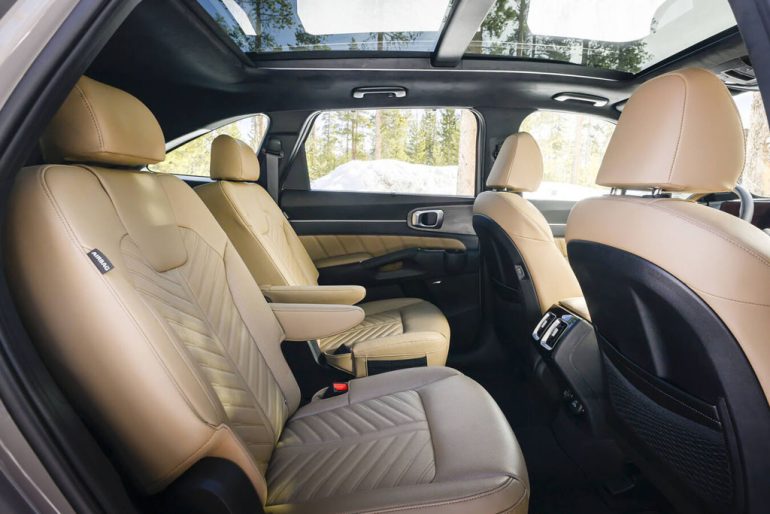
The Hybrid EX AWD is the standout value in the lineup. At $40,890 before destination, it is only $700 more than the gas EX AWD, delivers roughly 57 percent better combined fuel economy, and retains the full seven-seat configuration. In virtually any comparison of total ownership cost over four to five years, the Hybrid EX AWD closes that $700 gap quickly through fuel savings. It is the trim this article would recommend for the largest segment of Sorento buyers.
The gas SX FWD is a notable pricing anomaly. At $42,490, the SX FWD costs $500 more than the X-Line EX AWD at $42,990, yet the X-Line EX adds AWD, a unique appearance package, and X-Line-specific styling. For most buyers who do not have a specific reason to want FWD, the X-Line EX AWD at $42,990 represents a better value step than the SX FWD.
Email multiple Kia dealers simultaneously. Request the same configured trim from two to three dealers in your market with a single email asking for their best out-the-door price. The Sorento’s tight invoice gaps mean manufacturer incentives and dealer motivation matter more than the gap alone. Out-the-door is the only number worth comparing: documentation fees, dealer-installed accessories, and add-on packages vary widely between stores and can offset a seemingly lower selling price.
The three-row midsize SUV segment includes the Toyota Highlander, Honda Pilot, Hyundai Santa Fe, Subaru Ascent, Volkswagen Atlas, Chevrolet Traverse, and Kia’s own Telluride. The Sorento is the smallest of these in exterior dimensions but one of the most competitive in content per dollar at equivalent price points.

The Toyota Highlander starts around $41,000 and offers a hybrid variant starting around $48,000. The Honda Pilot starts around $40,000 with no hybrid option. The Hyundai Santa Fe is a close sibling to the Sorento on a shared platform and offers a PHEV variant as well. The Sorento’s most direct comparison is the Santa Fe, which is also available in gas, hybrid, and PHEV forms at broadly similar price points with similar powertrain specs.
The Sorento’s principal advantages over the field are Kia’s 10-year/100,000-mile powertrain warranty, the breadth of powertrain choice across three technologies at overlapping price points, and the Hybrid’s strong fuel economy. Its main competitive limitation relative to larger entries like the Traverse and Pilot is third-row practicality: the Sorento’s third row is functional for children but tight for adult passengers on longer trips. Buyers who regularly need to seat adults in the third row should evaluate the larger-footprint alternatives. For buyers whose third row is occasional-use and who want a well-equipped, warranty-strong three-row SUV with a choice of gas, hybrid, or plug-in power, the 2027 Sorento is among the most competitive offerings in its price range.

Darryl Taylor Dowe is a seasoned automotive professional with a proven track record of leading successful ventures and providing strategic consultation across the automotive industry. With years of hands-on experience in both business operations and market development, Darryl has played a key role in helping automotive brands grow and adapt in a rapidly evolving landscape. His insight and leadership have earned him recognition as a trusted expert, and his contributions to Automotive Addicts reflect his deep knowledge and passion for the business side of the car world.