As Reuters recently reported, a growing number of automakers and battery suppliers are trying to turn an EV slowdown into a new opportunity by shifting factory capacity toward stationary battery storage. On paper, the move makes sense. Data centers, cloud computing, and AI infrastructure are driving a sharp rise in electricity demand, and large-scale energy storage is becoming a bigger part of that conversation. For companies that spent years pouring money into EV battery production, the storage business suddenly looks like one of the few bright spots on the board.
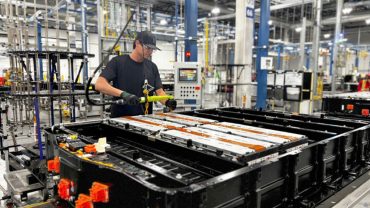
The problem is that this is not a simple plug-and-play pivot. Battery plants built around EV demand cannot instantly become storage factories overnight, and the economics are not nearly as clean as they may sound in a headline. Reuters notes that many of these conversions require new chemistry, more capital, and a long lead time before meaningful output arrives. A factory built with one mission in mind often needs substantial reworking to produce batteries better suited for stationary storage, especially as lithium iron phosphate chemistry becomes more important in that part of the market.
Even if the transition goes smoothly, the demand side still may not be strong enough to rescue all the excess capacity built for EVs. Benchmark Mineral Intelligence, cited by Reuters, expects North American stationary battery demand to reach 76 gigawatt-hours this year and 125 GWh within five years. That sounds impressive until you stack it against the roughly 275 GWh of battery factory capacity the auto industry has already built or planned around EV expectations. In other words, storage may help soften the blow, but it is not going to neatly mop up the overbuild created during the industry’s most optimistic EV growth years.
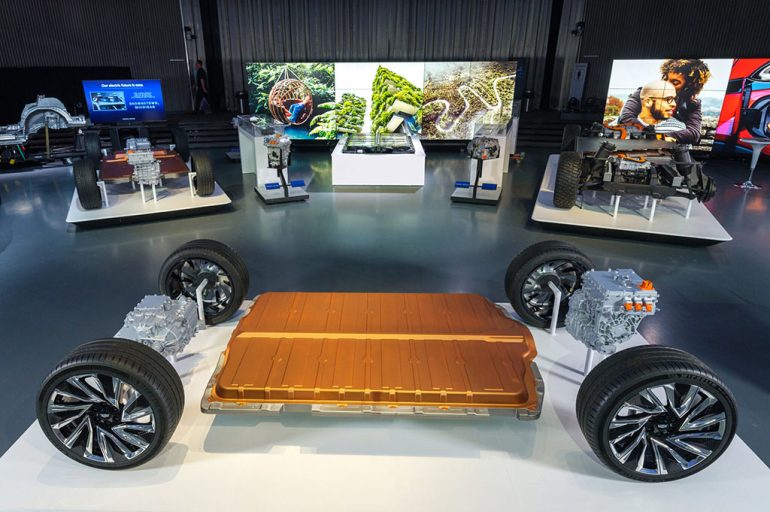
That is why companies like Ford, GM, LG Energy Solution, Panasonic, Samsung SDI, and others are now trying to be more flexible instead of simply waiting for EV demand to rebound. Ford is committing $2 billion over the next two years to build out a battery storage business, while GM and LG Energy Solution are moving ahead with plans to convert some battery production for storage use. These are not small side projects anymore. They are becoming a practical hedge against a market that has not developed the way many executives once expected.
Still, the company everyone else appears to be chasing is Tesla. Reuters points out that Tesla has spent years building its energy storage business into something meaningful, and by 2025 that division had become more profitable than its core automotive business on a gross margin basis. That is a striking detail, and it helps explain why legacy automakers are suddenly taking the storage side more seriously. Tesla got there early, stayed committed, and is now benefiting from demand that stretches well beyond traditional renewable energy projects and into AI-driven infrastructure growth.
There is also a geopolitical wrinkle that makes this transition even harder. Much of the battery storage world still depends on supply chains and know-how heavily tied to China, especially for LFP technology and key upstream materials. Reuters also highlighted the pressure created by tariffs, domestic content rules, and the race to qualify for federal production incentives. So while the narrative may sound like a straightforward American manufacturing reset, the reality is far messier. Building a self-sustaining domestic battery ecosystem for both EVs and storage is possible, but it is going to take time, money, and far more patience than many in the industry would probably like.
The takeaway here is that battery storage is becoming a very real strategic lifeline for automakers, but it is not a magic fix for the EV market’s growing pains. Reuters framed it well by showing both the urgency and the limitations of this shift. Carmakers are adapting because they have to, not because the road ahead is easy. For now, storage offers hope, flexibility, and maybe a more stable long-term business. It just does not offer a quick escape route from the consequences of betting so heavily on EV demand arriving faster than it actually did.

Lloyd Tobias is a seasoned automotive journalist and passionate enthusiast with over 15 years of experience immersed in the world of cars. Whether it’s exploring the latest advancements in automotive technology or keeping a close pulse on breaking industry news, Lloyd brings a sharp perspective and a deep appreciation for all things automotive. His writing blends technical insight with real-world enthusiasm, making his contributions both informative and engaging for readers who share his love for the drive. When he’s not behind the keyboard or under the hood, Lloyd enjoys test driving the newest models and staying ahead of the curve in an ever-evolving automotive landscape.