Forced induction, in the form of supercharging or turbocharging, coaxes more horsepower out of an engine by cramming in more air. Both methods have fans and detractors, and both methods have their strengths and weaknesses. Superchargers are typically belt driven and therefore scavenge a small-but-measurable amount of power from the engine to operate. Turbochargers use spent exhaust gasses to drive a turbine and compressor, and therefore offer essentially free horsepower.
Turbochargers, however, have their limitations as well. Generally speaking, a smaller turbo, with a low-mass impeller, will spool up quickly but can’t produce significant power beyond midrange. Larger turbos take longer to spool up, (thus producing turbo lag), but typically generate more boost and produce a broader range of power. Twin-turbo systems, which have been in use for years, generally employ both small and large turbos to optimize power delivery across the broadest range possible.
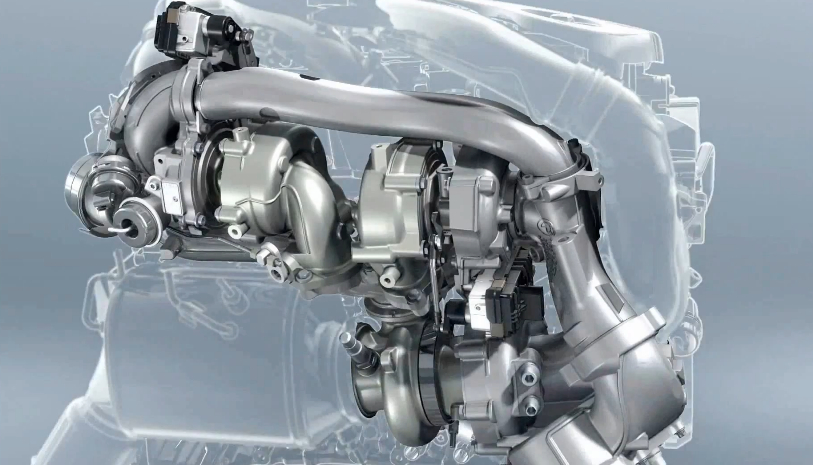
If two turbos are better than one, then three turbos, if properly sized and sequenced, are better than two. That’s the thinking behind the TwinPower Turbo system (which, ironically, uses three turbos) that BMW is employing on the new, diesel-powered M550d xDrive sedan. At low engine speeds, a small turbo provides near-instant boost, before handing the force-feeding duties off to a second, slightly larger turbo. At high engine speeds, a third small turbo comes on line, ensuring that the additional power is delivered seamlessly across an engine’s speed range.
If you get the feeling that the system is complex, you’re correct. As the video below, courtesy of BMW Blog, demonstrates, the plumbing linking the turbos to the engine is complex, and the two smaller turbos benefit from variable geometry compressors. When working optimally, the system should produce impressive power and torque, delivered across an engine’s entire speed range. When something breaks out of warranty, however, owners may not have the option of taking the car to a local mechanic for repairs.
It’s a moot point for those of us on this side of the pond, anyway, since BMW isn’t importing any of the three-turbo diesel models to these shores. That’s probably a good thing, since it allows our Euro neighbors to fully de-bug the system before it comes to the United States. If it comes to the United States.

Kurt Ernst has been passionate about automobiles and driving nearly his entire life. His early years were shaped working in the family service station, though his real passion was auto racing. After graduating from the University of Colorado, Kurt spent a year club racing with the Sports Car Club of America, before focusing on a business career in marketing and project management. Later, his passion for writing and the automotive hobby found him freelancing for a variety of automotive news sites, including Automotive Addicts and Motor Authority, where his work was syndicated and appeared in several national publications. Recognized as an expert in the automotive field, Kurt joined Hemmings Motor News as an Associate Editor in 2013, and in the years since has progressed to Editor, Hemmings Daily; Managing Editor for Hemmings Motor News, Hemmings Classic Car, Hemmings Muscle Machines, and the Hemmings Daily; and now, Managing Editor, Hemmings Auctions. Kurt was instrumental in organizing the Hemmings Motor News Concours d’Elegance from 2013-2019, and has served as a judge at this event and The Vintage Racing Stable Concours d’Elegance. A Skip Barber Racing School graduate and prolific writer, Ernst is also skilled in copyediting, project management, brand development, and public relations.