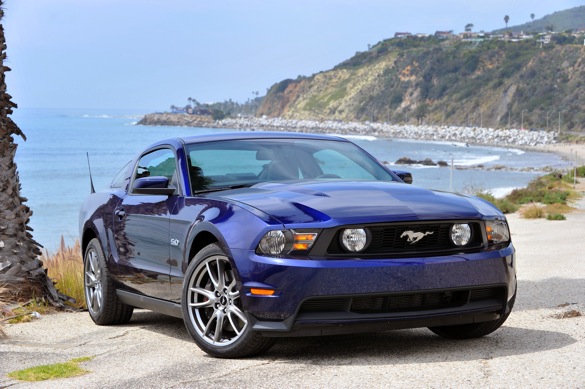
The 2011 Ford Mustang GT. Image: Ford Motor Comapny
Perhaps more than any other kind of vehicle, muscle cars are meant to be modded. In the old days, that generally involved a new intake manifold, a bigger carburetor, a high-lift, long duration cam and a new exhaust system from the headers back. Today, squeezing more ponies out of your car is generally done by reflashing the ECU, followed by a low restriction intake and high flow exhaust. Aftermarket blower or turbo kits can add serious horsepower, but often require additional upgrades (to the cooling system or clutch, for example) to handle the added power. The point is this: muscle cars are still meant to be modded, both to personalize them and to squeeze the last bit of horsepower from the engine.
A new Technical Service Bulletin from Ford may give owners of 2011 and 2012 5.0-liter Mustangs (and F-150s) cause for concern. In it, Ford advises against modifying any powertrain components or calibration to increase performance, as doing so may exceed the design limits of parts. To increase owner paranoia, Ford says that, “attempting to increase the engine output via recalibrating the PCM may result in poor drivability, DTCs (trouble codes), or component failures. The TSB even has a flowchart, with the ominous step of “Initiate warranty cancellation process” if a reflash or hardware modification is found to be the cause of the component failure.
So what does this mean? Not much, really, since the Magnuson-Moss warranty act of 1975 prevents manufacturers from voiding your entire warranty based on aftermarket modifications. They can still void sections of your warranty, or deny warranty claims based on mods, but the burden of proof is on the dealership. Reflash the ECU and throw a connecting rod, and you’ll be paying for the repair yourself, since the dealer will claim the software change exceeded the design limits of the engine. Add aftermarket wheels and tires (with no other mods) and throw a rod, and the dealership will be fixing your ride under any warranty you have left. If the component failure is unrelated to the modifications made, the dealer still has an obligation to honor your warranty; if the component failure is in any way related to the mod, plan on writing a check for repairs yourself.
This could potentially be another black eye for Ford, who’s already dealing with six-speed transmission failures on 2011 and 2012 Mustangs and bent rear frame assemblies on SVT Raptor pickups. The TSB really doesn’t say anything new, but it does indicate a change in focus for the automaker; once content to look the other way in regards to mods like intakes, headers and exhausts, it seems that Ford dealers will now actively look for reasons to void warranty claims.
Source: MustangsDaily, via AutoGuide

Kurt Ernst has been passionate about automobiles and driving nearly his entire life. His early years were shaped working in the family service station, though his real passion was auto racing. After graduating from the University of Colorado, Kurt spent a year club racing with the Sports Car Club of America, before focusing on a business career in marketing and project management. Later, his passion for writing and the automotive hobby found him freelancing for a variety of automotive news sites, including Automotive Addicts and Motor Authority, where his work was syndicated and appeared in several national publications. Recognized as an expert in the automotive field, Kurt joined Hemmings Motor News as an Associate Editor in 2013, and in the years since has progressed to Editor, Hemmings Daily; Managing Editor for Hemmings Motor News, Hemmings Classic Car, Hemmings Muscle Machines, and the Hemmings Daily; and now, Managing Editor, Hemmings Auctions. Kurt was instrumental in organizing the Hemmings Motor News Concours d’Elegance from 2013-2019, and has served as a judge at this event and The Vintage Racing Stable Concours d’Elegance. A Skip Barber Racing School graduate and prolific writer, Ernst is also skilled in copyediting, project management, brand development, and public relations.