
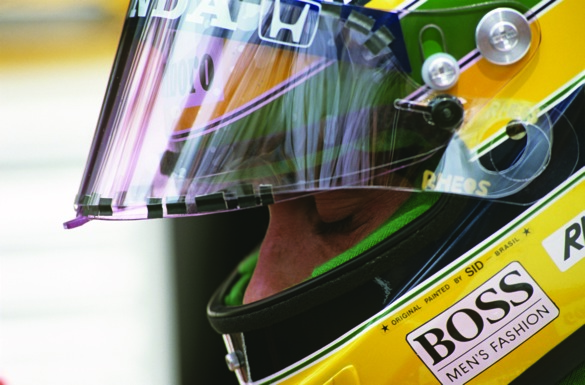
Image courtesy of Producers Distribution Agency
Ayrton Senna da Silva died on May 1, 1994, when his Williams Renault left the track and hit a concrete barrier at the Tamburello corner during the San Marino Grand Prix. Officially, the accident happened when Senna’s car, on cold tires and a full fuel load, bottomed out and momentarily lost traction. Although the car left the track at almost 190 miles per hour, Senna had slowed the car down to 135 just before the moment of impact, and his Williams hit at what appeared to be a glancing blow.
If you’ve seen the crash, it strikes you as unremarkable; many drivers have walked away from far worse impacts. For Senna, it was not to be; the Brazilian driver, who many consider to be the greatest F1 driver of all time, was killed by blunt force trauma from the impact of the right front wheel against his helmet, coupled with two penetrating head wounds from suspension uprights. If Senna was a legend during his career, he’d become the closest thing to racing’s patron saint after his death.
Trying to capture the essence of a personality like Senna’s is near impossible. Those close to him considered Senna to be almost a force of nature, not just another headstrong athlete. He was a driver that physically could not accept losing, and his battles with other stars of the era (especially Alain Prost) are the stuff of legend.
“He never wanted to beat me,“ Prost said of Senna, “he wanted to humiliate me. He wanted to show the people he was much better.”
Of their on-track rivalry, Senna had a different perspective, saying, “All drivers go for their limits. My limits are different from Prost’s.”
If you ever saw Senna race, chances are you’ll do everything in your power to see his biopic, “Senna,” now in limited release nationwide. If you never saw the complete mastery that Senna displayed on a wet racetrack, or his utter indifference towards anything but crossing the finish line first, the movie is a look into an era of Grand Prix racing that’s come and gone. Today’s drivers have talent, but Senna was the last of the Formula One giants, who put everything on the line each and every time they strapped into a race car.
For dates, showtimes and cities, check out the official “Senna” website.
Kurt Ernst has been passionate about automobiles and driving nearly his entire life. His early years were shaped working in the family service station, though his real passion was auto racing. After graduating from the University of Colorado, Kurt spent a year club racing with the Sports Car Club of America, before focusing on a business career in marketing and project management. Later, his passion for writing and the automotive hobby found him freelancing for a variety of automotive news sites, including Automotive Addicts and Motor Authority, where his work was syndicated and appeared in several national publications. Recognized as an expert in the automotive field, Kurt joined Hemmings Motor News as an Associate Editor in 2013, and in the years since has progressed to Editor, Hemmings Daily; Managing Editor for Hemmings Motor News, Hemmings Classic Car, Hemmings Muscle Machines, and the Hemmings Daily; and now, Managing Editor, Hemmings Auctions. Kurt was instrumental in organizing the Hemmings Motor News Concours d’Elegance from 2013-2019, and has served as a judge at this event and The Vintage Racing Stable Concours d’Elegance. A Skip Barber Racing School graduate and prolific writer, Ernst is also skilled in copyediting, project management, brand development, and public relations.